
 By
By Qatar Central Bank AFAQ Payment System: Why the Gulf’s Money Grid Just Went Live
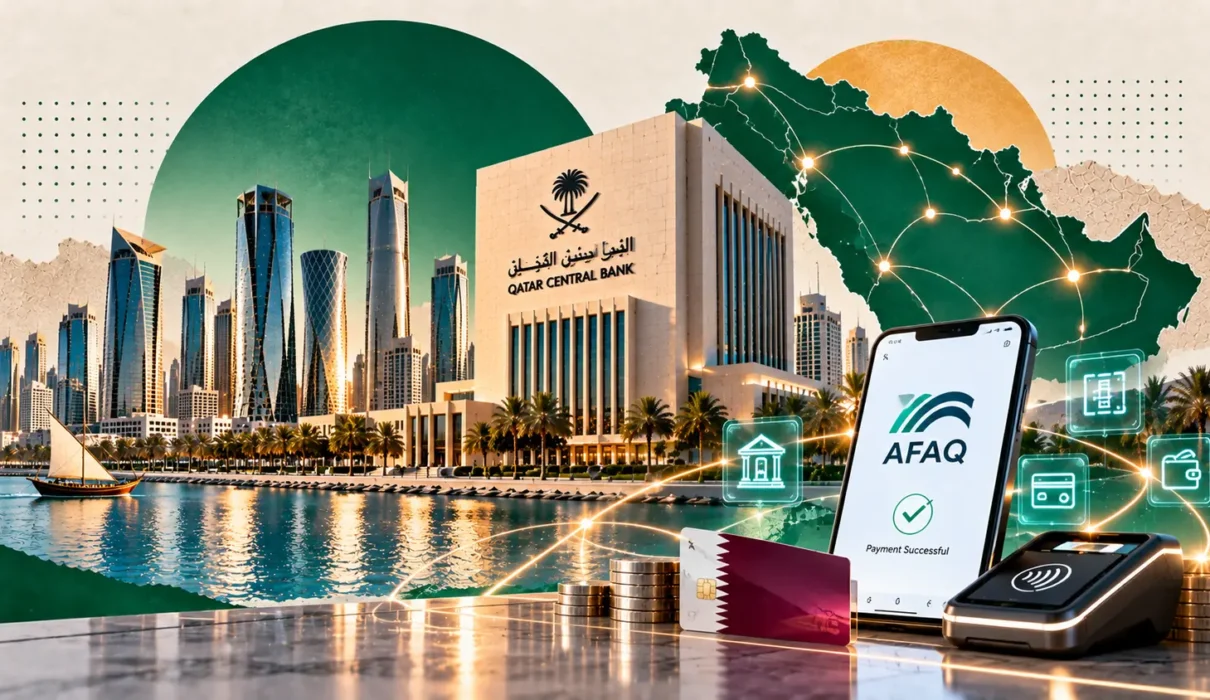
Qatar Central Bank has joined the AFAQ payment system, closing the last gap in a regional network that now links every central bank in the Gulf Cooperation Council. The move, confirmed by QCB on September 7 and reviewed again at a GCC governors’ meeting in Manama on September 14, gives businesses and banks a faster, cheaper way to move money between the six Gulf states.
- Qatar Central Bank joined the AFAQ payment system on September 7, 2026, completing participation by all six GCC central banks.
- Three Qatari lenders, Doha Bank, Qatar International Islamic Bank and Dukhan Bank, are among the first commercial banks in the country to connect, taking the GCC-wide total to 74 participating banks.
- GCC central bank governors reviewed the rollout at their 87th committee meeting in Manama on September 14, alongside talks on banking supervision, cybersecurity and anti-money laundering cooperation.
Qatar Central Bank AFAQ payment system completes the GCC network
Qatar Central Bank announced on September 7 that it had formally joined AFAQ, the regional payments system operated by the Gulf Payments Company. The step meant every GCC central bank, Saudi Arabia, the UAE, Kuwait, Bahrain, Oman and now Qatar, was finally connected to a single settlement network, according to GCC Business News.
QCB called it a milestone for the region’s financial plumbing. The bank said the connection would strengthen ties between Qatar’s payment infrastructure and the wider AFAQ network already used by lenders across the Gulf, per The Peninsula Qatar.
Three Qatari commercial banks joined alongside the central bank: Doha Bank, Qatar International Islamic Bank and Dukhan Bank. They are among the first Qatari lenders live on the system, and their addition pushed the total number of participating banks across the GCC to 74, The Peninsula reported.
What AFAQ actually does
AFAQ launched on December 10, 2020, and connects the real-time gross settlement systems of GCC member states through a private network, according to the Gulf Payments Company. It settles transfers in local currency, whether that is the Qatari riyal, UAE dirham, Saudi riyal, Bahraini dinar, Kuwaiti dinar or Omani rial, at real-time speed and with no hidden markup on the exchange rate.
That matters for businesses that currently route Gulf-to-Gulf payments through correspondent banks abroad, a process that can take days and layer on fees. AFAQ is designed to settle those same transfers in minutes, using digital certificates and public key infrastructure to secure the data, GCC Business News reported.
Officials expect commercial bank participation to keep growing as the system matures. The Peninsula, citing Qatar News Agency, said further rollout is expected to support trade, business and investment flows across the bloc.
Governors reviewed the rollout in Manama
The timing lines up with a broader push on Gulf financial integration. On September 14, Qatar Central Bank governor Sheikh Bandar bin Mohammed bin Saoud Al-Thani represented Qatar at the 87th meeting of the GCC Committee of Central Bank Governors, held in Manama alongside the 23rd board meeting of the Gulf Payments Company and the 66th meeting of the Gulf Monetary Council’s board, according to The Peninsula Qatar.
Bahrain’s central bank governor, Khalid Ebrahim Humaidan, chaired the session as part of the kingdom’s rotating GCC chairmanship, with GCC Secretary-General Jasem Mohamed Albudaiwi also attending. The committee’s remit at these sessions has typically run wider than payments alone. A similar governors’ meeting earlier this year covered banking supervision, cybersecurity information-sharing and anti-money laundering coordination across the bloc, according to The Daily Tribune Bahrain.
For Qatar, the AFAQ connection arrives at a sensitive moment for its banking sector. The country has spent much of 2026 managing the financial fallout of the wider US-Israel-Iran war, including a government-backed liquidity push into domestic banks and a slowdown in public lending. A faster, cheaper regional settlement rail does not fix those pressures, but it does give Qatari banks another tool to keep money moving with neighbors at a time when speed and cost matter more than usual.
Why it matters for businesses and banks
The practical effect is narrower payment friction between Gulf states. A Qatari exporter paying a Saudi supplier, or a UAE-based bank settling with a Kuwaiti counterparty, can now do it over a shared rail instead of relying on international correspondent networks. That is a meaningful shift given how much intra-GCC trade and investment already flows between these six economies.
It also fits a pattern GCC governments have leaned on all year: building financial infrastructure that reduces reliance on external intermediaries. Gulf lenders have faced tighter scrutiny from US correspondent banks over sanctions compliance in 2026, and a functioning domestic settlement network gives regional banks an alternative that does not depend on Western clearing relationships.
Commercial bank sign-up is still early. Only three Qatari banks are live so far, and the wider GCC total of 74 leaves room for most of the region’s mid-sized and smaller lenders to join over time. How quickly the rest of Qatar’s banking sector, including Qatar National Bank and Qatar Islamic Bank, connects will be the next thing to watch.
Qatar Central Bank AFAQ payment system: what comes next
With every GCC central bank now on AFAQ, the Gulf Payments Company’s next task is expanding commercial bank coverage and adding services beyond basic transfers. The company has flagged plans for multilateral clearing and outsourced domestic payment services for national central banks that want them, according to its own published roadmap.
For now, the Qatar Central Bank AFAQ payment system connection stands as the clearest sign yet that Gulf states are treating financial infrastructure, not just oil and gas, as core to their economic integration. Investors and businesses tracking Gulf banking should expect more incremental announcements as additional lenders come online through the rest of 2026.
Read more on how Qatar’s government has been shoring up bank liquidity this year.
Sources: GCC Business News, The Peninsula Qatar, The Peninsula Qatar, The Daily Tribune Bahrain, Gulf Payments Company.