
 By
By Key takeaways
- Knowledge Economic City Company and Dar Al Majed Real Estate have formed an SAR2.8 billion ($750 million) private real estate fund for a mixed-use project in Medina.
- The development includes 2,700 residential apartments, 8,000 square metres of commercial space and more than 3,500 parking spaces.
- The project is explicitly targeting non-Saudi buyers, even though property in Mecca and Medina is legally restricted to Saudi companies and Muslim individuals.
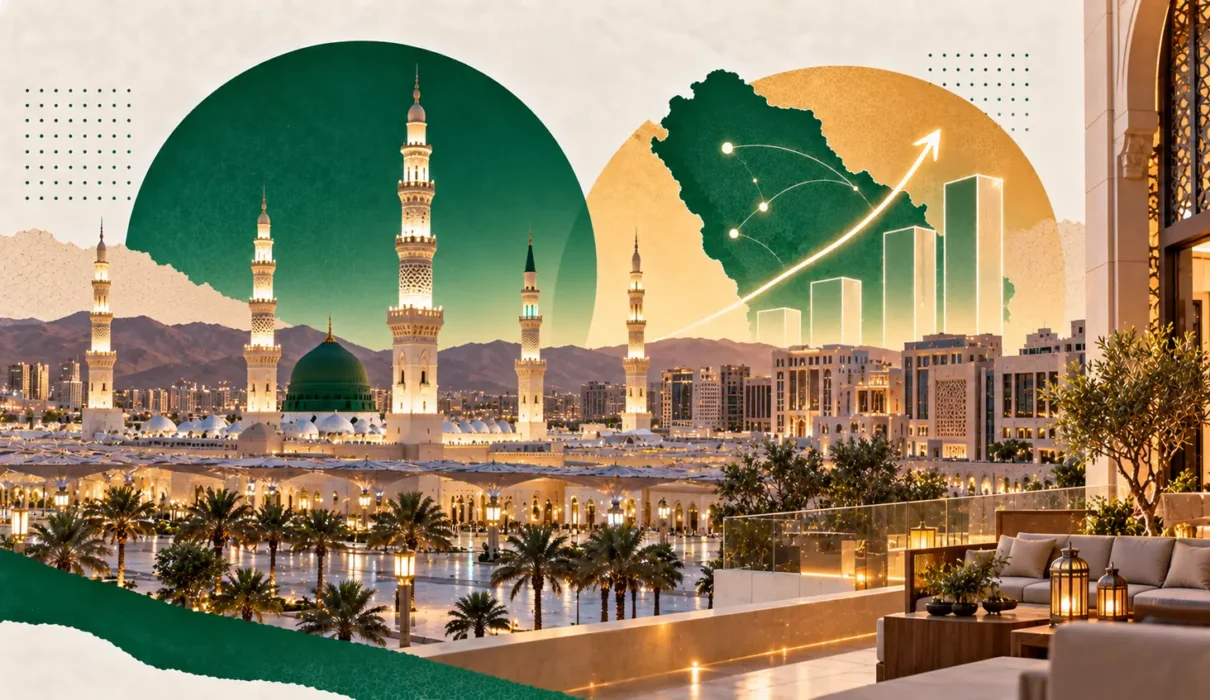
A Saudi real estate fund worth SAR2.8 billion, roughly $750 million, is being built in Medina with a specific buyer in mind: the non-Saudi investor. Knowledge Economic City Company, known as KEC, has teamed up with Dar Al Majed Real Estate, also known as Al Majdiah, to launch the mixed-use project, according to Arabian Gulf Business Insight.
The structure is straightforward on paper. KEC is contributing land valued at about SAR875 million and holds an 80 percent stake in the new fund. Al Majdiah is putting in SAR201 million in cash for the remaining 20 percent. Capital Hill, a Saudi asset manager, will run the fund day to day.
What the Medina real estate fund is actually building
The project itself is sizeable even by the standards of Saudi Arabia’s fast-moving property sector. Plans call for 2,700 residential apartments alongside a commercial component with 8,000 square metres of net leasable area and parking for more than 3,500 vehicles. That scale points to a development designed for long-stay pilgrims and residents rather than a boutique luxury play.
Medina, alongside Mecca, sits at the center of a religious tourism economy that draws millions of Umrah and Hajj visitors every year, and demand for well-located housing and retail near the holy sites has stayed strong regardless of broader swings in the Saudi property cycle.
The catch: holy city property has always been off-limits to foreigners
Here is where the Medina deal gets genuinely interesting. Ownership of real estate in Mecca and Medina has long been restricted under Saudi law to Saudi companies and to Muslim individuals, whether they hold Saudi nationality or not. Even Saudi-listed companies that own property in the two holy cities are capped at 49 percent non-Saudi ownership.
That restriction has not disappeared. What has changed is the broader backdrop around it. Saudi Arabia’s new Non-Saudi Property Ownership Law took effect in January 2026, and the kingdom has since launched the Saudi Properties platform, a centralized digital gateway meant to make the wider market easier for foreign capital to navigate. The Medina fund appears to be a test of how far developers can push toward foreign and diaspora buyers within the legal guardrails that still apply specifically to the two holy cities, most likely by courting eligible Muslim investors from outside Saudi Arabia rather than opening the project to all comers.
Why developers are chasing this buyer pool now
For KEC and Al Majdiah, the appeal is clear. Muslim investors across South and Southeast Asia, the wider Gulf and North Africa have long wanted a foothold near Islam’s second-holiest city, but have had few formal, professionally managed vehicles to do it through. A fund structure with an established land partner and a dedicated asset manager gives that pool of capital a cleaner entry point than piecing together an off-plan purchase directly from a developer.
It also fits a pattern playing out across Saudi Arabia’s real estate sector this year. Riyadh’s pipeline alone is said to include 57,000 new residential units, with sales in the capital reaching billions of riyals, as government-backed developers and private players race to meet both domestic demand and Vision 2030’s homeownership targets. Religious tourism cities are increasingly being packaged the same way, as investable real estate rather than purely as places of pilgrimage.
What to watch next
The fund has not yet disclosed a sales launch date or pricing for the 2,700 units, and it remains to be seen how strictly the non-Saudi buyer criteria will be enforced in practice. But the deal is a useful signal for anyone tracking Saudi Arabia’s real estate opening: even in its most legally protected cities, developers are now structuring products specifically to capture foreign and diaspora capital, not just domestic buyers.
Sources: AGBI, Middle East Briefing.
Read more: New Murabba CEO Change: Why Saudi Arabia’s $50 Billion Giga-Project Just Got a New Boss.