
 By
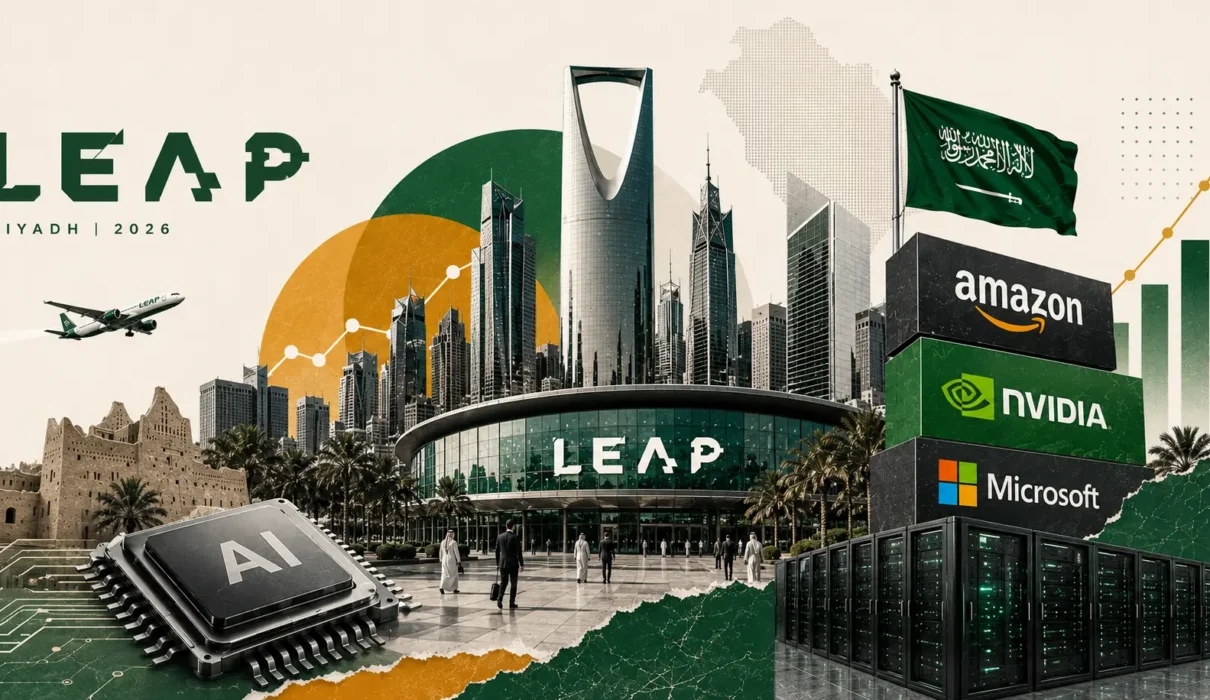
By LEAP 2026, Saudi Arabia’s flagship technology event, opened in Riyadh on August 31 with Amazon and Nvidia projects and an official Microsoft Azure launch on the agenda. The four-day gathering lands squarely inside the Kingdom’s self-declared Year of Artificial Intelligence, and it is already being framed by officials as evidence that Saudi Arabia has moved from buying technology to building and exporting it.
Key takeaways
- LEAP 2026 runs August 31 to September 3 at Riyadh’s Malham venue, with Amazon, Nvidia and Microsoft all set to make announcements.
- Saudi Arabia says it has exported more than 3,000 locally manufactured servers to neighbouring countries, part of a shift from tech importer to exporter.
- The Kingdom’s digital economy has grown more than 75 percent since Vision 2030 launched, reaching SAR52.2 billion and 410,000 jobs.
A fifth edition built around “Into New Worlds”
This year’s LEAP, themed “Into New Worlds,” is being staged at the Riyadh Exhibition and Convention Centre in Malham and organised jointly by Saudi Arabia’s Ministry of Communications and Information Technology, the Saudi Federation for Cybersecurity, Programming and Drones, and event company Tahaluf. Organisers expect more than 250,000 visitors, 1,800 technology companies, 600 startups, 1,000 speakers and upwards of 1,900 international investors to pass through the venue before it closes on September 3.
Communications and Information Technology Minister Abdullah Al-Swaha described LEAP as the largest technology movement of the 21st century at a press briefing ahead of the opening, noting that the event carries the backing of Crown Prince and Prime Minister Mohammed bin Salman. Running alongside the main exhibition is DeepFest, LEAP’s dedicated artificial intelligence programme, plus separate tracks for fintech, healthcare, smart cities, education, sport, space and gaming.
Amazon, Nvidia and Microsoft headline the announcements
The commercial centrepiece of opening day is a run of large technology commitments. Projects involving Amazon and Nvidia are due to be unveiled during LEAP 2026, and Microsoft is scheduled to officially launch its Azure cloud service in the Kingdom as part of the event. None of this is happening in isolation. LEAP’s four previous editions, held between 2022 and 2025, produced more than $42.4 billion in announced technology investment, and last year’s opening day alone generated a reported $14.9 billion in new AI commitments, including a $1.5 billion Groq-Aramco Digital partnership and a $2 billion Alat-Lenovo deal. Whether 2026 matches or beats that figure is the number investors in Riyadh this week will be watching most closely.
A digital economy that has already tripled in size
Al-Swaha used the pre-event briefing to lay out how far Saudi Arabia’s digital sector has come since Vision 2030 launched. The digital economy has expanded more than 75 percent to reach SAR52.2 billion, employment in the sector has climbed to 410,000 jobs, and the Kingdom says it now ranks first globally in digital competitiveness, spectrum liberalisation and digital readiness. Telecommunications coverage gaps have fallen from 50 percent to just 1 percent, and service disruptions are down to 5 percent, according to figures the minister presented.
Perhaps the clearest sign of the shift officials are pointing to is manufacturing. Saudi Arabia has exported more than 3,000 locally manufactured servers to neighbouring countries, Al-Swaha said, positioning the Kingdom as a producer rather than purely a consumer of the hardware underpinning the regional AI buildout. The government’s National Technology Development Programme has also backed more than 1,500 entrepreneurs and 5,000 companies, including nine that have reached unicorn status with valuations above $1 billion. Roughly 30,000 people have gone through AI training programmes at more than 80 technical schools nationwide.
Why this matters beyond Riyadh
For businesses across the Gulf, LEAP has become something closer to a scheduling anchor than a trade show. Vendor announcements, sovereign compute commitments and public procurement signals tend to cluster around the event, and this year’s shift from LEAP’s usual first-quarter slot to late summer, triggered by regional disruption earlier in the year, pushes that cluster into the same window as the Kingdom’s autumn events calendar. Sovereign wealth vehicles, chipmakers and hyperscale cloud providers are all expected to use the four days to formalise deals that have been under negotiation for months, building on infrastructure pushes already under way through HUMAIN and other state-linked AI ventures.
The practical test, as with previous editions, will be how quickly announced capital turns into running infrastructure. Committed billions and signed memoranda do not by themselves connect a data centre to a national grid or a model to a compliance framework, and that gap between announcement and operation is where much of the Gulf’s AI buildout has slowed in past cycles. Still, with Amazon, Nvidia and Microsoft all due on stage in Malham this week, LEAP 2026 is shaping up as one of the clearest single readings yet of how seriously global technology firms are treating Saudi Arabia’s AI ambitions.
Read more: HUMAIN Mistral AI Partnership: Inside Saudi Arabia’s Sovereign AI Push
Sources: Madhyamam, Noqta, Economy Middle East.