
 By
By Dubai’s aviation and hospitality sector just absorbed its toughest six months in years, and the numbers show it. Dubai airport traffic fell nearly a third in the first half of 2026, as the US-Iran war disrupted flight schedules and dragged down hotel occupancy across the emirate, though the second quarter already shows a steady climb back.
- Dubai International Airport handled 31.5 million passengers in H1 2026, as aircraft movements fell 32 percent year on year to just over 150,000.
- Monthly guest volumes recovered from 3.5 million in April to 5 million in June, tracking a broader rebound in capacity and airline schedules.
- The World Travel & Tourism Council forecasts the UAE will lose 46,000 tourism jobs this year, part of a wider 137,000 across the Gulf.
A Sharp Drop in Dubai Airport Traffic
Dubai Airports’ half-year results show 31.5 million passengers transited DXB in the first six months of 2026, while aircraft movements dropped 32 percent year on year to just over 150,000. Cargo volumes fell 29 percent to around 750,000 tonnes over the same period. The airport was still served by almost 50 international airlines flying to 217 destinations in 99 countries, but with far fewer flights than a year earlier.
Dubai Airports chief executive Paul Griffiths called the first half a test of “every part of the aviation system.” He said capacity is returning “steadily,” though it remains below where it stood at the start of 2026.
The Recovery Curve Through the Second Quarter
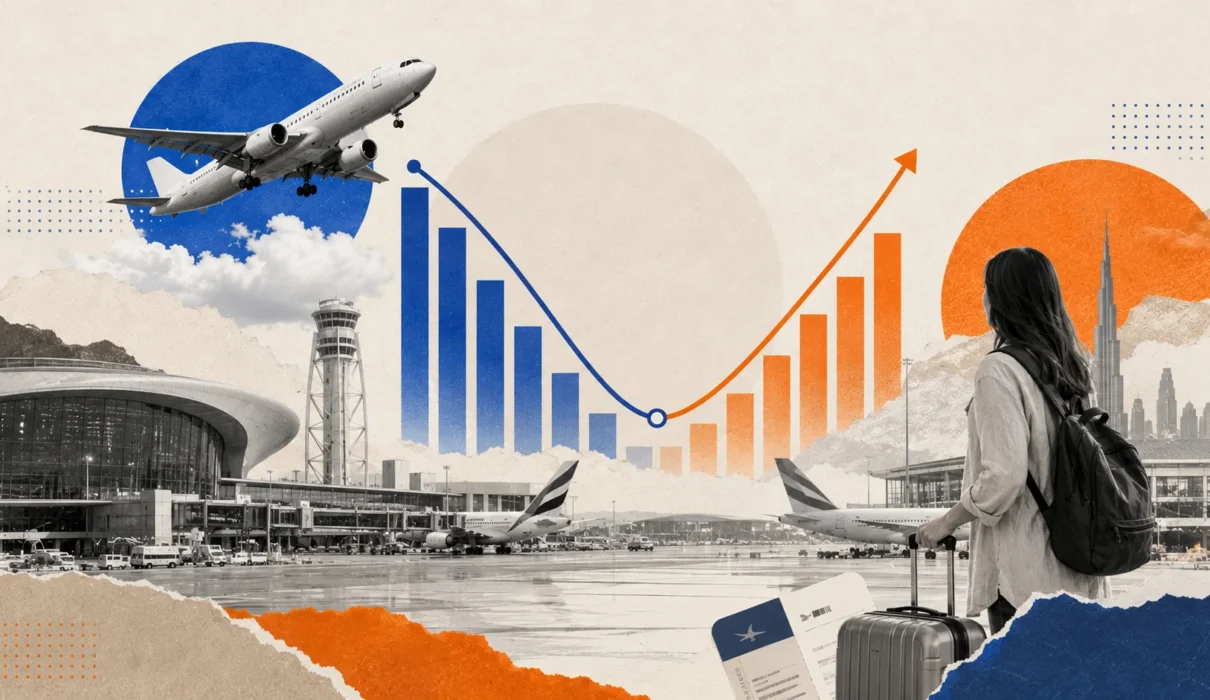
The trend within the first half tells its own story. Guest volumes climbed from 3.5 million in April to 4.5 million in May and 5 million in June, as airlines restored capacity and rebuilt schedules that had been slashed during the worst of the disruption.
A similar pattern shows up in UAE-wide entry permit data. Permits issued across the country fell from 1.94 million in February to 647,944 in April, a drop of about two thirds, before climbing back to roughly 1 million by July, still well below pre-war levels, according to figures from the Federal Authority for Identity, Citizenship, Customs and Port Security. Those figures span every category of entry permit, not just tourism, so the read-across to visitor numbers should be treated as indicative rather than exact. Even so, the trajectory closely tracks the aviation and hotel data.
Hotels Felt It Directly
- Marriott, Hilton and Hyatt all cited the war for double-digit declines in revenue per available room across the Middle East in the second quarter.
- Accor broke out the UAE specifically, with chief financial officer Martine Gerow saying activity was down about 80 percent year on year in April before recovering to a 40 to 45 percent decline by June.
- Average daily hotel rates have held up “to a point,” according to Philip Wooller, senior director for the Middle East and Africa at hospitality data firm STR, who noted Dubai’s scale as one of the world’s biggest hotel markets means rates are still under pressure.
Jobs and the Wider Tourism Picture
The hit to travel demand is showing up in employment forecasts too. The World Travel & Tourism Council expects the UAE to lose 46,000 tourism jobs this year, part of a wider 137,000 job losses forecast across the Gulf, as Middle East travel and tourism activity is projected to contract 14.5 percent, the only region expected to shrink in 2026.
Those numbers sit alongside a broader reshuffling within the UAE’s tourism sector. Ras Al Khaimah has leaned harder into domestic visitors as international arrivals slumped, while some investors are reportedly circling Dubai’s hotel market on the view that near-term weakness could open the door to acquisitions at better valuations than a year ago.
Confidence Problem, Not a Demand Collapse
Industry voices are drawing a careful distinction between the current slowdown and a structural decline in demand for the destination. “This was a temporary aviation and confidence-led disruption, not a demand collapse,” said Hala Matar Choufany, Middle East and Africa president at hospitality consultancy HVS.
“The Gulf isn’t facing a demand problem so much as a confidence and connectivity one, and those recover far faster,” Choufany added. That framing matches the shape of the data itself: passenger numbers, guest volumes and entry permits all bottomed out in April and have been recovering steadily since, even if none of them had returned to pre-war levels by July.
For Dubai’s tourism and hospitality operators, the second half of the year is likely to be less about whether Dubai airport traffic keeps recovering and more about how quickly the pace of that recovery can close the remaining gap to last year’s levels, and whether the confidence that underpins bookings holds if regional tensions flare again.
Read more: Gulf Tourism Jobs 2026: Why the Industry Is Bracing to Lose 137,000 Roles.