
 By
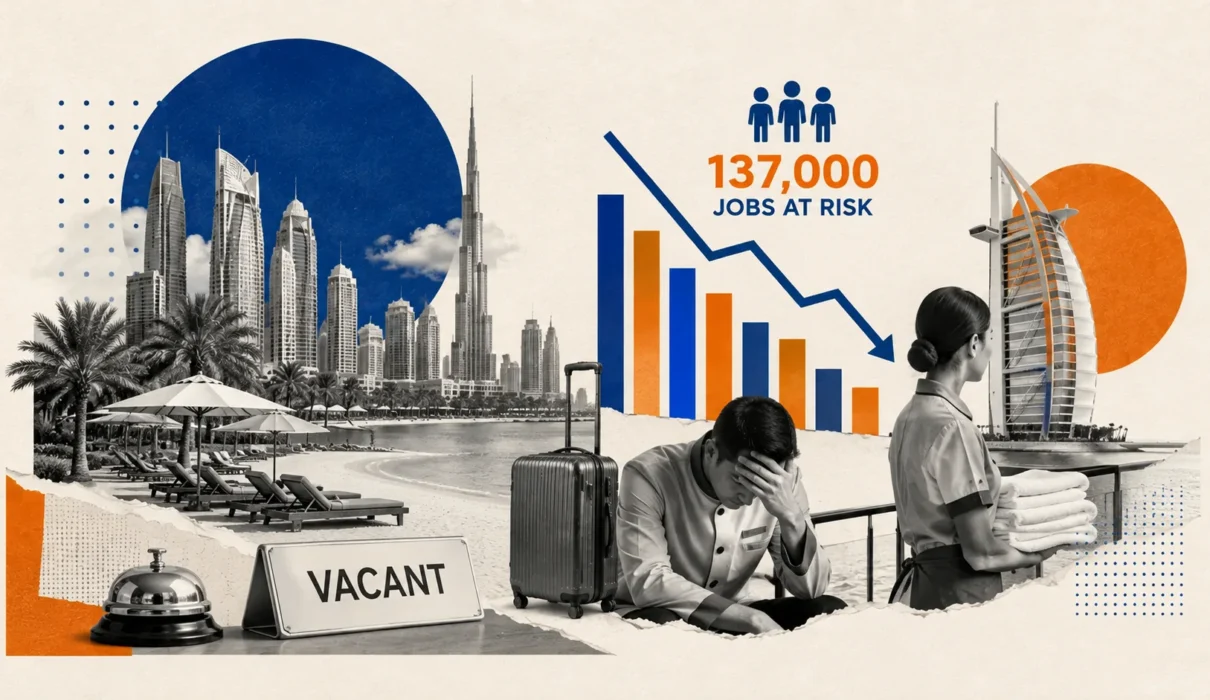
By The Gulf’s travel and tourism sector is on track to lose around 137,000 jobs this year, even as several of its hotel and real estate markets keep posting record numbers. The World Travel and Tourism Council (WTTC) forecasts a 4.3 percent drop in regional tourism employment for 2026, with Saudi Arabia and the UAE absorbing the biggest share of the losses as the US-Iran conflict continues to suppress visitor demand.
Key takeaways
- WTTC forecasts the GCC’s travel and tourism workforce, roughly 3.2 million people in 2025, will shrink 4.3 percent, a loss of about 137,000 jobs, this year.
- Saudi Arabia is projected to lose 69,000 roles and the UAE 46,000, together accounting for the vast majority of the regional decline.
- The conflict is already costing the Middle East travel and tourism sector at least $600 million a day in lost international visitor spending, according to WTTC.
A War That Keeps Draining Visitor Demand
The job losses trace directly back to nearly five months of conflict involving Iran, Israel and the United States, which has disrupted flight schedules, spooked international travelers and pushed up war-risk costs across the region. WTTC estimates the fighting is costing the Middle East’s travel and tourism sector upwards of $600 million a day in lost international visitor spending, a toll that has been building since fighting broke out earlier this year.
Hotel performance data backs up the scale of the hit. Middle East hotel occupancy fell 19 percent in the year to the end of July, while revenue per available room dropped 21 percent over the same period, according to industry estimates cited alongside the WTTC forecast. Airlines have pulled back on Gulf routes too, with Emirates only partially restoring Bahrain service by mid-August and Kuwait flights still fully suspended, further limiting the flow of visitors the hospitality sector depends on.
Saudi Arabia and the UAE Bear the Brunt
Saudi Arabia is forecast to lose 69,000 tourism jobs this year, the largest single-country hit in the Gulf, despite the kingdom’s continued investment in giga-projects and religious tourism infrastructure around Makkah and Madinah. The UAE follows with a projected 46,000 job losses, even as Dubai has worked to protect its position as the region’s most resilient leisure destination through relief measures like Dubai’s AED2.5 billion tourism support package covering fee exemptions for hotels and restaurants.
Together, the two countries account for the overwhelming majority of the Gulf’s projected job losses, reflecting both the size of their tourism workforces and their outsized exposure to long-haul international travel, the segment hit hardest by war-related disruption. Smaller Gulf tourism markets such as Bahrain and Oman face proportionally smaller job losses but have still reported steep hits to hotel profitability this year.
Recovery Signals, but Not Before Q4
Industry forecasts broadly agree that any meaningful recovery will not begin before the fourth quarter of 2026, and that occupancy levels are unlikely to return to pre-war norms before the end of 2027. In the meantime, some Dubai hotels have temporarily closed or moved up refurbishment plans to wait out the slump, with roughly 5,400 rooms pulled from the market since April and expected to return gradually through 2027.
For an industry that has spent the past several years building toward record visitor numbers and major event calendars, the WTTC figures are a reminder that geopolitics, not capacity or ambition, is now the single biggest variable determining how quickly Gulf tourism gets back on track. Employers in the sector are largely holding onto core staff and management talent while trimming more exposed frontline and seasonal roles, according to regional hiring trends tracked through the summer.
To see how one part of the sector is weathering the downturn, read: Accor Ibis Makkah Deal: Why Economy Hotels Are the Kingdom’s Next Bet.
Sources: AGBI, Salaam Gateway, WTTC.